Affirmations
What Is Manifesting? What It Means and What Actually Works
What manifesting means, where the law of attraction comes from, what the research shows, ten methods from 369 to WOOP compared, and a 4-step way to manifest that holds up.

On this page
- What is manifesting?
- What is the law of attraction?
- Does manifesting work?
- Which manifestation methods work? Ten compared
- How to manifest something in 4 steps
- 1. Pick one wish and write it in your own words
- 2. Make it visible
- 3. Name the obstacle and make an if-then plan
- 4. Check in and mark what came true
- How I manifest with a vision board
- What are the most common manifesting mistakes?
Manifesting means getting so clear on a wish, and keeping it so visible, that you can't ignore it. Then you act on it. The law of attraction adds that the Universe meets you halfway; that part is belief. There's good evidence that a clear wish plus a plan helps.
Here's what manifestation means, what the research says, ten methods from the 369 method to WOOP (Wish, Outcome, Obstacle, Plan) side by side, and four steps that hold up.
What is manifesting?
Manifesting is the practice of turning a wish into something you can see, like a sentence, a picture or a board, so it stays in front of you until you act on it. The spiritual version adds a belief: that focused thoughts and feelings draw the wish to you.
The word comes from manifest: to make clear or visible. That's the useful part. What you see every day is what you remember when it counts.
- Manifesting is the doing: writing the wish down, making a board, taking a step.
- Manifestation is the result, the wish that came true. People also use it for the practice itself, so the two often mean the same thing.
- Life areas are the parts of your life you manifest in, such as health, love, money or career. Other guides call them categories or sections. Same idea.
Cambridge Dictionary picked "manifest" as its 2024 Word of the Year, largely because of TikTok and celebrities crediting their success to it.
What is the law of attraction?
The law of attraction is the belief that like attracts like: positive thoughts bring good things, negative thoughts bring bad ones. It comes from New Thought, a 19th-century American movement, and modern manifesting grew out of it. It's a belief, not a law of physics (Wikipedia).
| When | Who | What |
|---|---|---|
| Mid-1800s | Phineas Quimby | Mental healing; the root of the New Thought movement |
| 1886 | Prentice Mulford | Describes thoughts attracting their match as a general principle |
| 1906 | William Walker Atkinson | Publishes Thought Vibration or the Law of Attraction in the Thought World |
| 2006 | Rhonda Byrne | The film and book The Secret take the idea worldwide |
You'll often read that Plato, Buddhism or quantum physics described the law of attraction first. They didn't. Karma is a teaching about the consequences of your actions. Quantum entanglement describes particles. Neither says your thoughts pull things toward you.
What does hold up: when you care about a goal, you notice more chances to move toward it, and you're more likely to take them. That's attention at work.
Does manifesting work?
Not the way the law of attraction promises: there's no evidence that thinking about a wish brings it to you. What helps is a clear wish, an honest look at what's in the way and a concrete plan. Daydreaming about the outcome alone can even hold you back.
| Study | What was tested | What it found | What it doesn't show |
|---|---|---|---|
| Oettingen & Mayer, 2002 | Four studies: job-seeking graduates, students with a crush, students before an exam, patients after hip surgery | People who expected to succeed tried harder and did better. People who just fantasized about a rosy future did worse. | It's a link, not proof: the fantasies were measured, not assigned. Optimism itself isn't the problem. |
| Gollwitzer & Sheeran, 2006 | A review of 94 tests of if-then plans ("If X happens, I'll do Y") | A medium-to-large effect on whether people reached their goal | Nothing about thoughts attracting anything. Newer reviews with far more tests found smaller effects. |
| Dixon, Hornsey & Hartley, 2023 | Three surveys of about 1,000 Americans on their belief in manifesting | About a third believed in it. Strong believers saw themselves as more successful but didn't earn more, were drawn to risky investments and were more likely to have been through a bankruptcy. | A link, not proof. The study can't say whether the belief leads to bankruptcy or the other way around. |
| Kappes & Oettingen, 2011 | Lab experiments: picturing an ideal future | Afterward, people had less energy, measured in part by blood pressure. | Short experiments. Whether people reached their goals wasn't measured. |
So the wish and the picture are only the start; the next step is what counts. For vision boards in particular, see Do vision boards work?
Which manifestation methods work? Ten compared
Most methods keep a wish in view, and there's no evidence any of them does more than that. The two parts with solid research are naming the obstacle and making an if-then plan. WOOP combines both.
| Method | What you do | Time | What's behind it | Our verdict |
|---|---|---|---|---|
| Vision board | Put pictures of your wishes on a board, sorted by life area | 20 minutes to start, then a minute a day | No study of boards themselves. A picture reminds you of your goal. | Good if you look at it daily and know one step for each picture |
| Scripting / journaling | Write about your wish as if it already came true, often as a journal entry from the future | 10–15 minutes | Writing makes a wish clearer. Writing "as if it's done" hasn't been studied. | Good for getting clear. End each entry with one real next step. |
| 369 method | Write one sentence 3 times in the morning, 6 times in the afternoon, 9 times at night, often for 21 or 33 days | About 10 minutes a day | A ritual. The link to Nikola Tesla is an internet attribution. | Keeps the wish on your mind. The numbers have no special power. |
| 3-3-3 method | Versions vary: write one sentence 3 times a day for 3 days, often with 3 minutes of visualizing | A few minutes | A ritual, no research | A gentle start for small wishes |
| 777 method | Write one sentence 7 times in the morning and 7 times at night for 7 days (there are many versions) | 5 minutes a day | A ritual, no research | Like 369, only shorter |
| 55×5 method | Write one sentence 55 times a day for 5 days | 15–20 minutes a day | A ritual, no research | A lot of writing. If you do it, save it for one clear wish. |
| Affirmations | Short sentences about yourself, said out loud or written down | 1–2 minutes a day | Lines you don't believe can backfire for people with low self-esteem (Wood et al., 2009). | Good with lines you can believe today. More in What are affirmations? |
| Visualization | Close your eyes and picture the goal | 5 minutes | Rosy pictures alone tend to drain energy (Kappes & Oettingen, 2011). | Only together with the obstacle; otherwise skip it |
| WOOP | Wish, best Outcome, inner Obstacle, if-then Plan (woopmylife.org) | 5 minutes | Gabriele Oettingen's research on mental contrasting, plus the evidence on if-then plans | The best-supported method. Our 4 steps below build on it. |
| 13 wishes ritual | Write 13 wishes on slips, burn one each night over the twelve nights after Christmas, and the last one is yours to make happen | 12 evenings around New Year's | A German folk custom (the Rauhnächte), no research. The last wish is the one you work on. | A lovely ritual for the turn of the year. Dates and how-to in our 13 wishes ritual guide. |
If you pick only one method, pick WOOP. If you like pictures, pair a vision board with WOOP. The steps below do exactly that.
How to manifest something in 4 steps
Pick one wish, make it visible, plan around the obstacle and set a date to check in.
1. Pick one wish and write it in your own words
Start with one wish, not ten. Make sure it's really yours, not your mom's or your feed's. And make it concrete enough that you can later say: done or not done.
- Instead of: "I want more money."
- Try: "By June 30, I've saved $3,000 for two weeks in Lisbon."
Seven rules with before-and-after examples, plus a free printable worksheet, are in How to write your wishes and manifestations.
2. Make it visible
Find a picture that feels like your wish and put it where you look every day: on a vision board, as a note on your mirror, in a screenshot folder on your phone. This is the part the word "manifest" means literally.

In VISIYA, you make your board on your iPhone or iPad, search for pictures right in the app and add your wish as a note. One board is free.

 Scan to download VISIYA on the App Store
3. Name the obstacle and make an if-then plan
Ask yourself: what in me is most likely to get in the way? Then make the plan: "If that happens, I'll …"
- Obstacle: "By the end of the month, the money goes to takeout and small stuff."
- Plan: "When my paycheck hits, I move $300 into my travel savings the same day."
That's WOOP in a nutshell, and it's the step with the best evidence.
4. Check in and mark what came true
Set a date: once a week, pick one step; after 30 days, a quick check-in. When a wish comes true, check it off that same evening. That small moment is your reward.
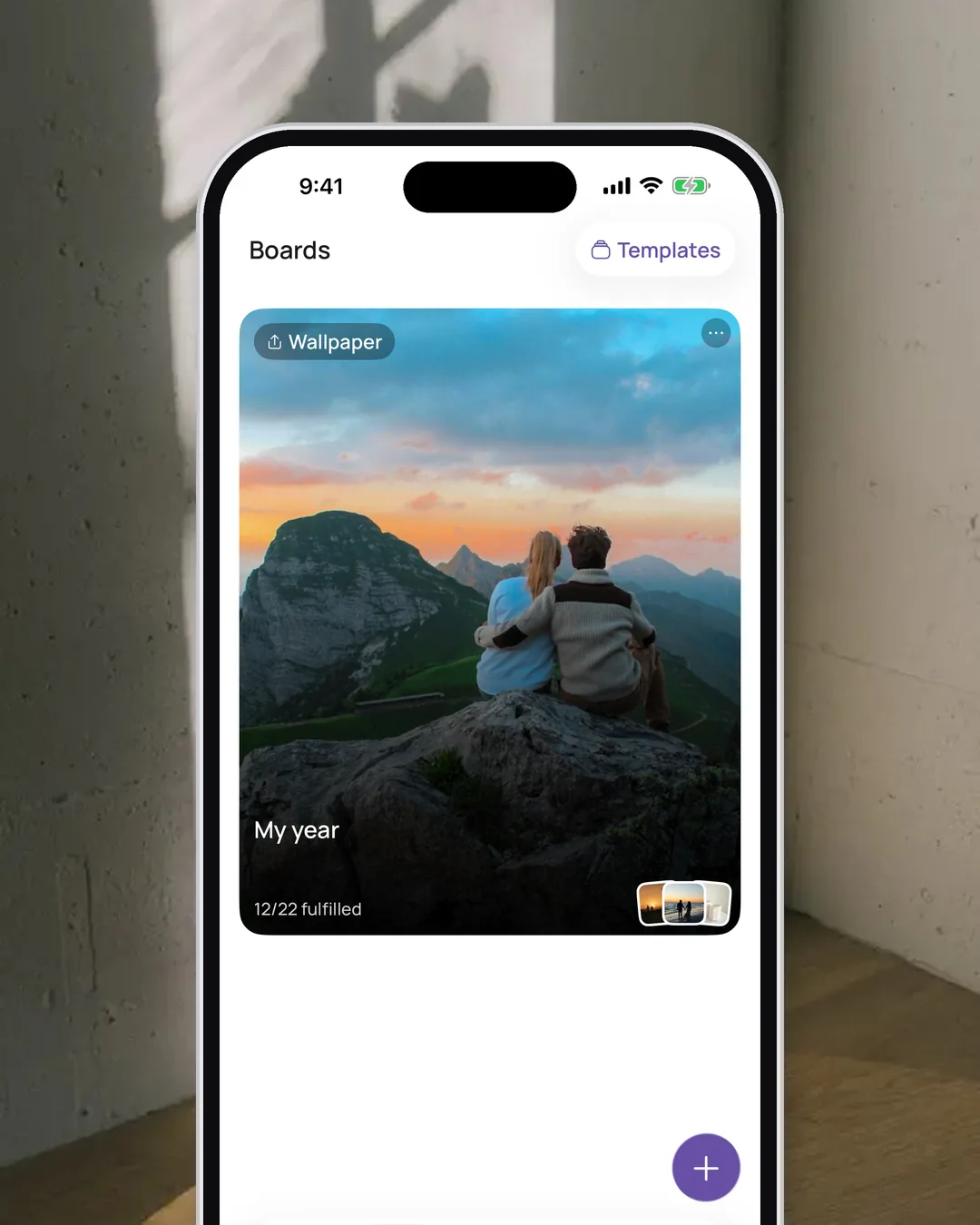
In VISIYA, you tap Mark as fulfilled, and your board keeps count. What the first 30 days look like, with a plan you can print, is in How to activate a vision board.
How I manifest with a vision board
I've made vision boards since I was a teenager, dozens of them by now, and I built the VISIYA app. My most honest takeaway: your vision board won't manifest anything. But it will show you what you're willing to work for.
The Universe has never delivered anything for me. I always delivered. The board reminds me and keeps me accountable.
And still, I believe that what truly belongs to me, what's meant for me, will happen anyway. My intuition is the key. That's where manifesting helps me: when I write a wish down and see it every day, I notice sooner whether it feels right.
And I trust the signs. I go through my days mindfully, with my eyes open, and I see messages from the Universe in them:
- a poster or something in nature that makes me stop,
- the right people at the right time, like an offer, a request to collaborate or an invitation,
- thoughts about the next step that keep coming back, even though I can't explain why.
Underneath it all is my inner belief that something is meant for me.
Here's how I do it:
- One board per year of my life. Every year around my birthday, I take stock: what came true, what didn't? No judgment.
- About half of it comes true. On my "34" board, the app shows "12/22 fulfilled." Some things turned out differently: I didn't make new friends, but the friendships I had got closer.
- A motto for the year. A color, a song or a sentence. For my 35th year, it was "radical visibility."
- One small wish, right away. Buy the book, take the walk, send the text. That's what gets a board going.
You don't need a perfect board. Take 20 minutes tonight and start; you don't have to wait for January 1. The full step-by-step is in How to make a vision board, and a good place to start is the free This Year I Will template.
For a daily affirmation, VISIYA has 40 topics, six of them free, including "Manifestation." If your wish is about money, read How to make a money vision board.
What are the most common manifesting mistakes?
Almost always, a step is missing. Belief is rarely the problem.
- Wishing without doing. Write one first step for every wish.
- Too many wishes at once. Start with one, or at most one per life area.
- Someone else's wish. Ask about each one: do I want this, or do I think I should?
- Pushing doubt away. Doubt points to the obstacle. Write it down.
- Blaming yourself. If something doesn't happen, you didn't "think wrong." Some things are out of your hands.
- Putting the board in a drawer. What you don't see, you forget.
Ten common mistakes, with a quick board check-up, are in Vision board mistakes.
Frequently asked questions
What does manifesting mean in simple terms?
Manifesting means naming a wish clearly, keeping it where you can see it and then working toward it. In spiritual circles it also carries the belief that your thoughts attract what you want. There's no evidence for that part. There is good evidence that a clear goal paired with a plan helps.
How long does it take to manifest something?
There's no set timeline, and numbers like 21 or 33 days have no basis. A small wish can come true within a week if you take the first step right away. For bigger wishes, check in after 30 days and take stock once a year.
What's the difference between manifesting and the law of attraction?
The law of attraction is a belief from the 19th-century New Thought movement: like attracts like, so positive thoughts bring positive things. Manifesting is the practice, the things you do, like making a vision board or writing down a wish. You can manifest without believing in the law of attraction.
Does the 369 method work?
As a writing ritual, it can keep a wish on your mind: you write it three times in the morning, six times in the afternoon and nine times at night. Nothing shows the numbers have any special power, and the link to Nikola Tesla is an internet attribution. Add one next step each time you write, and the ritual turns into a plan.
Is manifesting a sin?
It depends on your faith, and Christians disagree. Manifesting in the spiritual sense asks you to trust that your thoughts or the Universe will bring you what you want. Some Christians object to that because it puts your own will where they put God and prayer. A vision board is a different thing: a planning tool with pictures of goals you work toward, and people of any faith use one. Some Christians make it a prayer board.
Can you manifest a specific person?
No. You can't control what another person wants, and no ritual changes that. Write down how you want to feel in a relationship and what you can do yourself to get there. Our post How to Write Your Wishes and Manifestations shows how, with examples.